


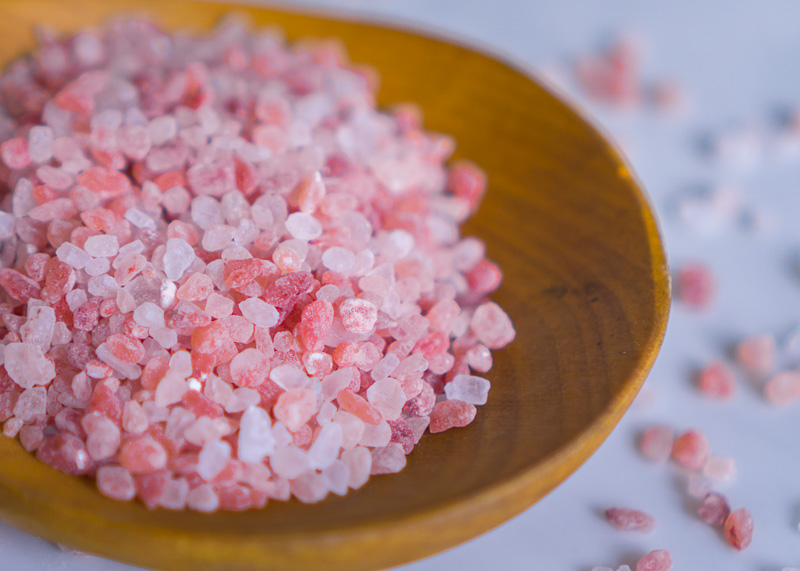
So often, we hear of the negative effects of salt. But what if I told you that salt can actually have positive health benefits? That is, if you choose the right one. I’d like to introduce you to pink Himalayan salt, which I use for food and relaxation. While reading this post, you’ll learn about some great reasons why you may want to consider taking a pink Himalayan salt bath.
What is pink Himalayan salt?
Pink Himalayan salt is a pink-coloured salt that is considered healthier than table salt as it is not chemically processed and contains no additives, compared to table salt, which contains anti-caking agents and bleach. The pink hue that gives this salt its name is due to the 84 trace minerals that it contains, including iron, potassium, magnesium and calcium.
The issue with table salt is that most of the beneficial minerals that are contained in natural salt are destroyed during its refining process. In addition to using pink Himalayan salt to flavour food, this salt is used to make salt lamps and serving dishes, such as baking stones and griddles. When added to food, I find it more flavourful and less chemical tasting than refined table salt. You may also have noticed that many spas offer salt therapies using pink Himalayan salt as a way to rejuvenate and recharge.
The history of pink Himalayan salt
Pink Himalayan salt mainly comes from the Khewra Salt Mine in Pakistan, the second largest mine in the world. This mine was discovered by Alexander the Great in 326 BC. Legend has it that Alexander the Great and his troops were passing through this area when they stopped to rest. When they saw their horses licking the surrounding rocks, they examined them and discovered that the rocks were actually salt. Salt in itself has a significant history that has been overlooked since the invention of refrigerators.
While salt is now ubiquitous and affordable, before the discovery of the many global salt deposits, salt was a scarcity and as such a valuable commodity, for many centuries. Before the refrigerator, the primary way to preserve food was with salt. Without salt, soldiers and explorers couldn’t travel very far because their supplies would spoil. Did you ever wonder what the origins are of the term “not worth his salt” or the word “salary”? The word “salary” comes from the Latin word “salarium,” which refers to the allowance soldiers were given to buy salt in the ancient Roman days. During that period, soldiers were either paid in salt or given a ration to buy the commodity. Being “worth salt” meant that you were deserved of what you were earning.
Watch this video about the history of salt:
A word of caution when it comes to consuming pink Himalayan saltWhile Himalayan salt is considered healthier than table salt as it contains 84 beneficial minerals, it is essential to note that this salt is still 98% sodium chloride. So while pink Himalayan salt may be healthier, it is still salt. That means it can still cause elevated blood pressure levels if consumed in excess. Like all forms of sodium, salt will cause health issues if not taken in moderation. Specifically, excess consumption of sodium increases the risk of high blood pressure. It is vital to consult with your healthcare provider before using salt as a food additive if you have pre-existing health issues. Make sure you consult with your healthcare provider if you have circulatory problems. Pink Himalayan salt baths can cause slight dizziness because of the impact they have on your circulatory system |
There are many reasons why you will enjoy pink Himalayan salt baths

Skin is the largest organ of the body and its health is a reflection of our internal health. Sadly, in today’s modern society, our skin is exposed daily to numerous toxins. Whether from the food we eat, the chemicals in personal products or the household products we use; the toxins are there. For that reason, I am a big proponent of taking pink Himalayan salt baths as a way to detox.
You may not know this, but salt baths have been part of human civilization for thousands of years. Salt baths date back to the time when the Greek philosopher Hippocrates discovered the therapeutic benefits of bathing in sea water. When you dissolve Himalayan salt in water, you create a rich blend that contains 84 trace minerals that parallel the minerals found in our bodies. While you can use other types of salt for bathing, pink Himalayan salt has recently become my preference for salt baths. Here are some reasons why you might want to consider taking a Himalayan salt bath:
#1: Pink Himalayan salt baths can soothe achy, tired muscles
If you find yourself on your feet all day or you are experiencing sore muscles, a warm salt bath can do wonders for your body. You can really feel your muscles relaxing after a warm salt bath. Be warned though – you may feel very sleepy afterwards, so make sure to take your bath closer to bedtime.
#2: A pink Himalayan salt bath can help improve your sleep
That’s because pure pink Himalayan salt can increase your levels of oxytocin, a hormone that It plays a role in social bonding, sexual reproduction, childbirth, and the period after childbirth. Increasing your levels of this hormone will help you feel calm and relaxed before bedtime.
As well, taking a bath two hours before bedtime will help you have a restful sleep. A study conducted by New York Hospital-Cornell Medical Center revealed that the steep body temperature drop from the bath to the natural temperature dip that happens at night creates a deeper sleep.
#3: Pink Himalayan salt baths help beat bloating and look (temporarily) slimmer
An interesting fact about salt baths is that you can reduce your waist and thigh size with a ten to twenty-minute bath! It’s true, and it’s often a beauty secret that is utilized by celebrities. Note that while Epson salts are often used, a pink Himalayan salt bath has the same positive effect.
#4: Pink Himalayan salt baths will leave your skin feeling softer and smoother
When you have a saltwater bath, the natural salt is absorbed into your skin and it purifies your pores from within your body. The salt then draws out toxins, thereby leaving your skin feeling supple and glowing. Your skin also absorbs the 84 types of minerals, leaving you feeling youthful and healthy. Salt baths have also been proven to help greatly with skin conditions such as eczema and psoriasis. That’s because pink Himalayan salt has antiseptic properties.
#5: Pink Himalayan salt baths help soothe blisters and insect bites
Pink Himalayan sea salt’s antiseptic, antibacterial and anti-inflammatory properties can provide relief from blisters or bites. A warm sea salt bath will soothe your itching or painful blisters.
#6: Pink Himalayan salt baths create a relaxing experience
Whether taken after a long day of work, during a cleanse or after an intense workout, salt baths are a great way to unwind. In today’s fast-paced society where most people have a jam-packed schedule, taking a salt bath is a great way to spend quality time alone. When combined with essential oils, pink Himalayan salt baths create an aromatherapy experience
What you need to take a pink Himalayan salt bath
- Bathtub
- About one pint of pink Himalayan salt
- A glass of water to stay hydrated
- Spa music (my albums “Spa” and “Beyond Dreams” are good examples).
- Candles
- Essential oils (optional)
Instructions for taking a pink Himalayan salt bath
- Shower and wash thoroughly to prepare for your bath.
- Fill a tub with a few inches of hot water.
- For a full spa experience, turn on some relaxing spa music and light some candles. You can also add some essential oils to enhance the experience.
- Add Pink Himalayan Salt and stir the water until the salt dissolves. While you can use any type of Pink Himalayan Salt, the finer salt will dissolve faster in water.
- Continue filling your bathtub with very warm water. The ideal water temperature is 97 degrees Fahrenheit (36 degrees Celsius).
- Enter the bathtub and soak your body for at least 20-30 minutes. Try to avoid getting salt in sensitive areas, such as eyes or inner ears. If you feel dizzy or light-headed, add cold water to the tub or add a cold cloth over your head.
- Once finished, get out of the tub slowly and use a towel to pat your skin. It is important not to rinse off the salt from your body.
- Rest for at least 30 minutes as your muscles will feel very relaxed. Now is an excellent time to have some herbal tea or read a book.

When and how often should you take pink Himalayan salt baths?
By indulging in this relaxing activity at least once a week, you can reap significant health benefits. Some people will take salt baths depending on the phases of the moon.
CONCLUSION
Himalayan salts contain trace minerals and help the body to detox and relax. Now that you’ve learned some of the benefits of taking a salt bath, the next step is to take a salt bath!
Come back and share your experience with me on the blog. I’d love to hear how you felt after your salt bath.
Please share this post with someone who will benefit from taking a Himalayan salt bath!
 Spectrum has been selected as one of the Best new Age Music Albums of 2011 by John P. Olsen of


